Automation is transforming businesses of every size, but the approach varies significantly between small and large organizations. Here's what you need to know:
- Small businesses focus on affordable, easy-to-implement tools like CRM platforms, email marketing automation, and no-code solutions. Their smaller size allows for quick decision-making and faster adoption of automation to streamline tasks like scheduling and invoicing.
- Large enterprises leverage advanced systems such as ERP platforms, robotic process automation (RPA), and AI-powered analytics. These tools handle complex workflows across multiple departments, requiring longer implementation timelines and collaboration among stakeholders.
Key Differences:
- Budget: Small businesses prioritize cost-effective solutions, while large enterprises invest in scalable, custom-built systems.
- Complexity: Small businesses use straightforward tools, whereas large organizations manage intricate, multi-department workflows.
- Decision-making: Small businesses move quickly, while large enterprises take a phased, structured approach involving multiple teams.
Quick Comparison:
| Aspect | Small Businesses | Large Enterprises |
|---|---|---|
| Budget | Limited; focus on affordable tools | Larger; invest in enterprise-grade solutions |
| Tools | Plug-and-play software like CRMs, SaaS | Advanced platforms like ERP, RPA, AI |
| Implementation | Quick, hands-on | Phased, structured with pilot testing |
| Decision-making | Owner-driven, fast | Collaborative, involving multiple teams |
Whether you're running a small startup or a large corporation, automation can optimize operations and free up resources for growth. The key is tailoring your strategy to your business's size and needs.
The 7 Automation Tools Your Businesses Can't Live Without
Main Differences in Automation Approaches: Small vs Large Businesses
The journey toward automation looks very different for small and large businesses. While both aim to boost efficiency, their strategies are shaped by distinct constraints and resources. Let’s break down how these differences influence their automation choices.
Resource Allocation and Budget Limits
Small businesses often work with tighter budgets, so they prioritize automation tools that provide quick and measurable returns. They lean toward all-in-one platforms that handle multiple tasks and come with pricing options that fit their cash flow. These businesses typically look for solutions that are affordable and straightforward, ensuring every dollar spent delivers noticeable value.
On the other hand, large enterprises have the financial muscle to invest in custom-built solutions and enterprise-grade platforms. With larger budgets, they can afford tools that offer scalability and integrations tailored to their sprawling operations. They’re also more comfortable with longer timelines for seeing returns, as their focus extends to long-term efficiency and growth.
Technology Adoption and Complexity
Small businesses gravitate toward simple, plug-and-play tools that don’t require advanced technical skills. Cloud-based software with user-friendly interfaces is a favorite, especially Software-as-a-Service (SaaS) platforms that handle updates and maintenance automatically. Early automation efforts often focus on straightforward tasks like email marketing, appointment scheduling, or managing customer relationships. Over time, they expand their automation as their needs grow.
In contrast, large enterprises deploy more advanced and layered automation systems. These systems are designed to handle complex workflows across multiple departments. They invest in cutting-edge technologies like robotic process automation (RPA) and advanced analytics platforms. Dedicated IT teams manage these systems, ensuring seamless integration, data security, and compliance with regulations. Their automation efforts are built to handle large-scale operations and sophisticated data processing.
Decision-Making and Implementation Processes
The way decisions are made also highlights the divide between small and large businesses. Small businesses tend to move quickly, with decisions often made by the owner or a small team. This agility allows them to test new tools, make adjustments based on feedback, and directly oversee the setup and results. Their approach is hands-on, ensuring that the tools align closely with their immediate goals and workflows.
Large enterprises, however, face a more complex decision-making process. Multiple stakeholders - ranging from IT teams to procurement and senior leadership - are involved. Their evaluations are meticulous, often including pilot programs to test compatibility before committing. Implementation is a structured process, with clearly defined phases, extensive testing, and gradual rollouts to minimize disruptions and ensure smooth integration into their broader operations.
Automation Tools and Strategies for Small Businesses
Small businesses often face tight budgets and limited resources, making it essential to find automation solutions that are simple to set up, affordable, and adaptable. Below are some of the best tools and practical strategies to help small businesses integrate automation effectively.
Best Tools for Small Business Automation
- Customer Relationship Management (CRM) platforms: These tools streamline contact management, track deals, and automate follow-ups, all while offering pricing options that fit smaller budgets.
- No-code automation platforms: Tools like Zapier and Microsoft Power Automate make it easy to connect apps and automate repetitive tasks without needing programming expertise.
- Email marketing automation platforms: Automate campaigns such as welcome emails or regular updates using customizable templates and scheduled delivery.
- Accounting and invoicing software: Simplify tasks like generating invoices, categorizing expenses, and preparing financial reports, saving time and reducing errors.
- Social media scheduling tools: Plan and schedule posts in advance, track engagement, and maintain a consistent online presence without daily manual effort.
Once you've chosen the right tools, the next step is implementing them effectively.
Practical Implementation Tips
- Focus on key tasks: Start by automating high-priority activities like handling customer inquiries or scheduling appointments.
- Ensure compatibility: Select tools that work seamlessly with your current systems to avoid disruptions.
- Take advantage of free trials: Test tools before committing to ensure they meet your needs.
- Introduce changes gradually: Roll out new automation tools step by step, providing clear instructions or tutorials to ease the transition.
- Track performance: Use simple metrics to measure the success of your automation efforts and refine your workflows as needed.
- Start small: Begin with basic automations involving one or two steps, then expand to more complex systems as you become comfortable.
sbb-itb-5ef22c3
Automation Tools and Strategies for Large Businesses
For large enterprises, automation operates on a much broader and more intricate scale compared to small businesses. These organizations deal with complex structures, multiple departments, and significant budgets, which allow them to adopt advanced automation technologies. However, their primary challenge lies in coordinating these tools across vast operations while ensuring security, compliance, and seamless integration. Unlike the simpler tools often used by smaller businesses, the solutions for large enterprises are designed to meet their expansive operational requirements.
Enterprise-Level Automation Tools
Large businesses rely on a range of sophisticated automation tools to streamline their operations:
- Robotic Process Automation (RPA): RPA platforms are essential for handling high volumes of repetitive tasks across various departments. From processing invoices to employee onboarding, these tools can interact with legacy systems, manage irregularities, and scale to meet the demands of enterprise-level operations.
- Enterprise Resource Planning (ERP) Systems: ERP platforms with automation capabilities act as the operational backbone for large organizations. These systems synchronize data across departments, trigger workflows based on predefined rules, and offer real-time insights. Tasks like adjusting inventory, generating purchase orders, and forecasting maintenance needs are automated seamlessly.
- Artificial Intelligence and Machine Learning: AI and ML platforms empower large enterprises to automate complex decision-making processes. These tools can analyze customer behaviors, optimize supply chains, and enhance forecasting accuracy, leveraging the vast datasets that large organizations can provide.
- Business Intelligence (BI) Dashboards: BI tools automate the collection, processing, and visualization of data from multiple sources. They generate reports, highlight trends, and even deliver predictive analytics and automated recommendations, helping managers make informed decisions without manual intervention.
- Enterprise Integration Platforms: These platforms address the challenge of connecting numerous software systems within a large organization. They ensure data consistency, synchronize information, and manage complex cross-department workflows.
Together, these tools create a foundation for a disciplined and phased approach to automation implementation.
Implementation Process for Large Organizations
When it comes to automation, large enterprises take a structured, methodical approach. Implementing automation at this scale often spans months or even years and involves several key stages:
- Process Mapping and Analysis: This initial phase involves documenting existing workflows, identifying inefficiencies, and pinpointing opportunities for automation. For large organizations, this step often uncovers processes that span multiple departments, requiring careful coordination and planning.
- Pilot Testing: Before rolling out automation on a large scale, companies typically conduct pilot tests in a single department or for a specific process. This allows them to verify compatibility, refine workflows, and address any issues related to security, compliance, or integration.
- Stakeholder Alignment: Successful automation implementation requires collaboration across the organization. IT teams, business units, compliance officers, and executive leaders must work together to ensure the automation strategy aligns with overall business goals. Cross-functional teams and clear governance structures are often established to streamline this process.
- Phased Rollouts: Instead of deploying automation across all departments at once, large enterprises adopt a staged approach. This minimizes risks, allows teams to learn from each phase, and provides an opportunity to fine-tune the implementation process.
- Change Management and Training: With so many employees impacted by automation, effective change management is critical. Large organizations invest heavily in training programs, detailed documentation, and support systems to ensure employees can adapt to new processes smoothly.
This careful and deliberate approach ensures that large businesses can harness the full potential of automation while minimizing risks and disruptions.
AI-Powered Workflow Diagnostics with Privagent - Dave the AI Consultant
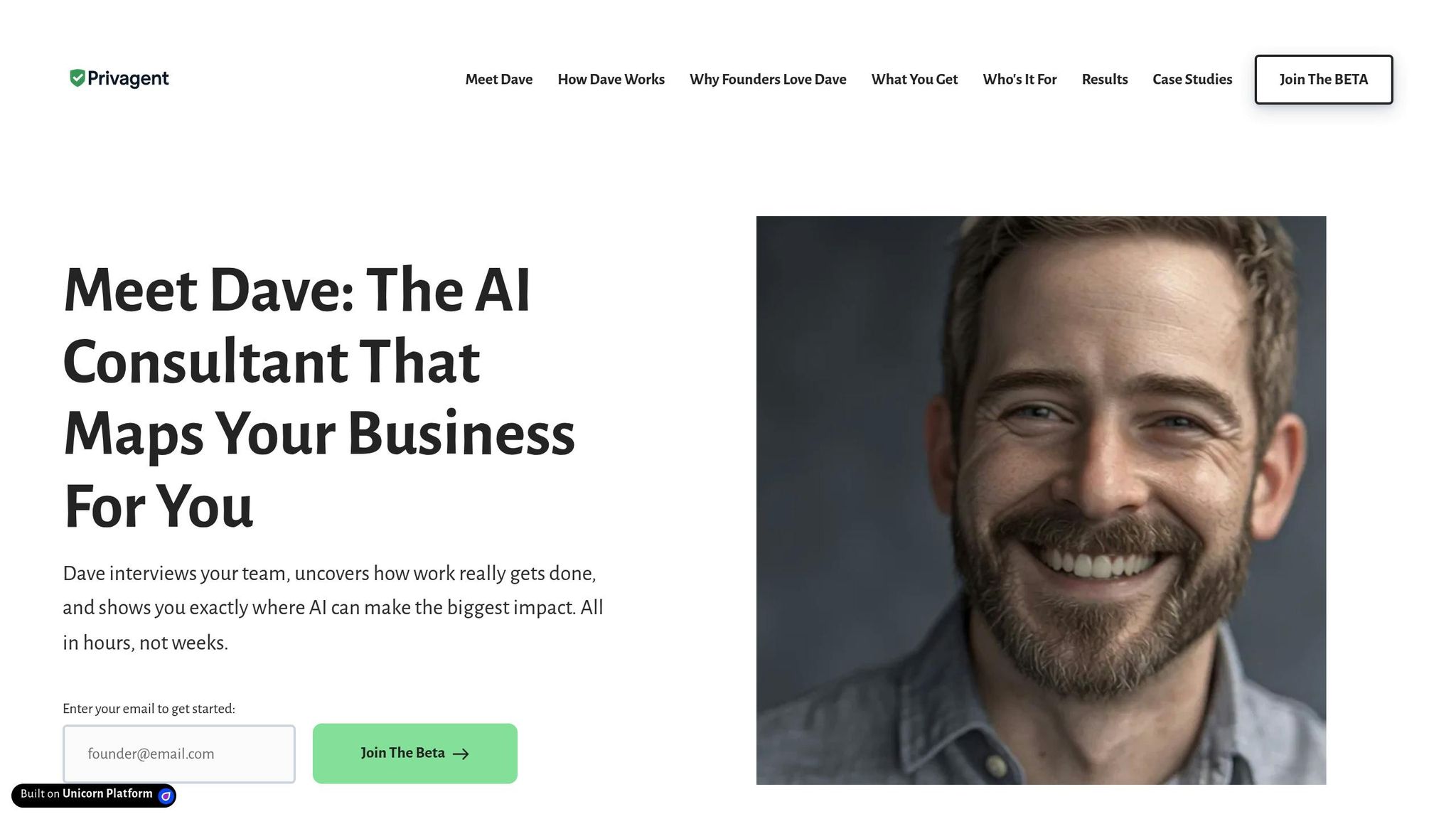
Every business, whether small or large, faces a similar challenge: figuring out where automation can make the biggest difference. Privagent - Dave the AI Consultant steps in to tackle this by analyzing an organization’s processes with precision and speed.
Unlike older methods that rely on manual observations and lengthy evaluations, Dave uses AI to accelerate the diagnostic process. By conducting structured employee interviews, analyzing workflow patterns, and delivering actionable insights, the platform transforms how businesses identify automation opportunities. Here's a closer look at how it all works.
How Privagent - Dave the AI Consultant Works
Dave kicks off the process by interviewing employees across different departments. These interviews are designed to uncover day-to-day tasks and recurring challenges - details that might not always be visible to management. This approach ensures no stone is left unturned.
Once the data is collected, Dave combines AI-driven analysis with expert reviews to provide recommendations that are both technically sound and practical. The platform pinpoints inefficiencies and bottlenecks, creating visual reports with process maps that clearly highlight areas ripe for automation. These maps are paired with prioritized recommendations to help businesses take action.
To ensure data security, all information is handled with strict confidentiality and robust encryption, safeguarding sensitive business details.
Benefits for Small Businesses
For small businesses, where resources are often stretched thin, Dave offers tailored insights that align with their unique needs. Whether it’s integrating a CRM, simplifying workflows, or improving specific processes, the platform identifies practical solutions that don’t require a massive overhaul.
Department-specific summaries allow leaders to see how team time is spent and where efficiencies can be gained. For those needing extra support, optional strategy sessions are available to help plan and implement automation initiatives seamlessly, minimizing disruptions.
Benefits for Large Businesses
For larger enterprises, Dave’s diagnostic process adapts to the complexity of analyzing workflows across multiple departments. The platform efficiently uncovers inefficiencies on a broader scale, offering insights that cater to diverse organizational needs.
Dave provides phased implementation plans, allowing companies to test changes in smaller areas before rolling them out organization-wide. Case studies from successful automation projects help build confidence among executives. Detailed technical recommendations are paired with high-level summaries, ensuring both leadership and operational teams are equipped to drive automation efforts effectively.
Choosing the Right Automation Strategy for Your Business
To make automation work for your business, it’s essential to align your strategy with your company’s size and specific challenges. This ensures you’re not just adopting technology for the sake of it but driving meaningful results where they matter most.
Matching Automation Goals with Business Size
For small businesses, the focus should be on affordable, easy-to-implement solutions that solve pressing problems. Think tools for customer relationship management, invoicing, or inventory tracking. These systems are designed to save time and allow small teams to concentrate on growing revenue without getting bogged down in tedious processes.
On the other hand, large enterprises need systems that can scale across departments. Features like enterprise-grade security, regulatory compliance, and advanced integrations are critical. These businesses often deal with complex workflows, so their automation needs to handle multiple processes simultaneously while ensuring long-term returns.
The main distinction here is resource allocation. Smaller businesses often look for quick wins, automating one process at a time to see immediate benefits. Larger companies, however, can afford to take a broader approach, tackling multiple workflows and planning for longer implementation timelines.
Budgets also play a big role. Small businesses typically lean toward cost-effective tools, while larger organizations can invest in comprehensive systems that may require significant upfront costs but deliver greater efficiency in the long run. These differences shape everything from the tools you choose to the complexity of the implementation process.
Once you’ve aligned your goals with your business size, it’s time to map out a clear implementation plan.
Next Steps for Implementing Automation
Start by mapping out your processes to pinpoint bottlenecks and repetitive tasks. Prioritize automation for tasks that are frequent, time-consuming, or prone to errors. This ensures your efforts are targeted and impactful.
One way to streamline this step is by using tools like Privagent - Dave the AI Consultant, which analyzes your operations and highlights inefficiencies. With data-driven insights, you can skip the guesswork and focus on actionable solutions tailored to your business.
Roll out automation systematically. For smaller businesses, this might mean starting with customer onboarding or streamlining invoice processing. Larger enterprises might focus on areas like supply chain management or compliance reporting, where automation can deliver significant returns.
Don’t forget to define clear success metrics upfront. Track improvements like time savings, error reduction, and employee satisfaction to measure the impact of your automation efforts. These metrics will not only justify your investment but also guide future decisions.
Finally, support your new systems with proper training. Ensuring your team understands and embraces the changes will maximize the benefits of automation.
FAQs
How do automation benefits differ for small businesses and large enterprises?
Automation brings tailored benefits to businesses of all sizes, addressing their unique challenges and goals.
For small businesses, it’s a game-changer. By automating repetitive tasks, small teams can save valuable time and focus on what truly matters - building customer relationships and driving growth. This is especially helpful when resources are tight, making every minute and dollar count.
For large enterprises, automation takes efficiency to a new level. It ensures processes are consistent, documentation is thorough, and large-scale operations run smoothly. It also simplifies managing complex workflows, helping different departments stay aligned and operate with precision.
When businesses - big or small - adapt automation to their specific needs, they can boost productivity and position themselves for long-term growth.
How can small businesses select the right automation tools while staying within budget?
Small businesses can keep costs in check by zeroing in on automation tools that tackle their most time-consuming tasks. Start by pinpointing repetitive processes, like managing customer relationships or tracking inventory, that eat up valuable time and resources.
To keep expenses under control, focus on tools with flexible features that can adapt as your business grows. Seek out solutions with tiered pricing options, so you’re only paying for what you actually use. Don’t forget to explore free trials or demos to make sure the tool meets your needs before committing to a purchase.
By prioritizing the essentials and evaluating options wisely, you can boost efficiency without breaking the bank.
What challenges do large businesses face with complex automation systems, and how can they address them?
Large businesses often face hurdles when adopting new automation processes. Challenges like gaining company-wide buy-in, merging various systems, and handling enormous data volumes can create roadblocks. These obstacles not only slow down the rollout but can also limit the impact of automation.
To overcome these issues, companies should emphasize strong change management, ensure employees receive thorough training, and leverage reliable integration platforms to enable smooth communication between systems. Focusing on these areas can simplify operations and help businesses unlock the full potential of automation.